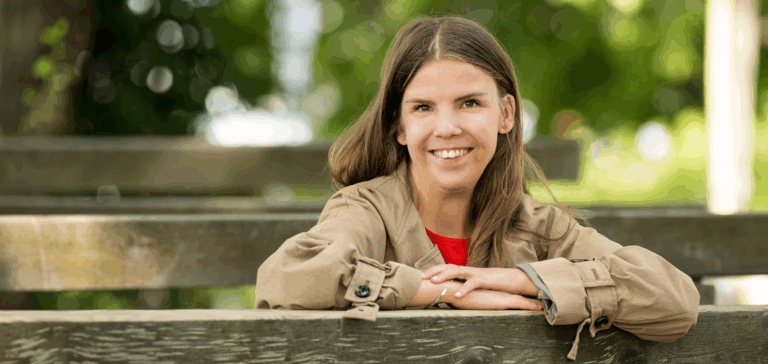
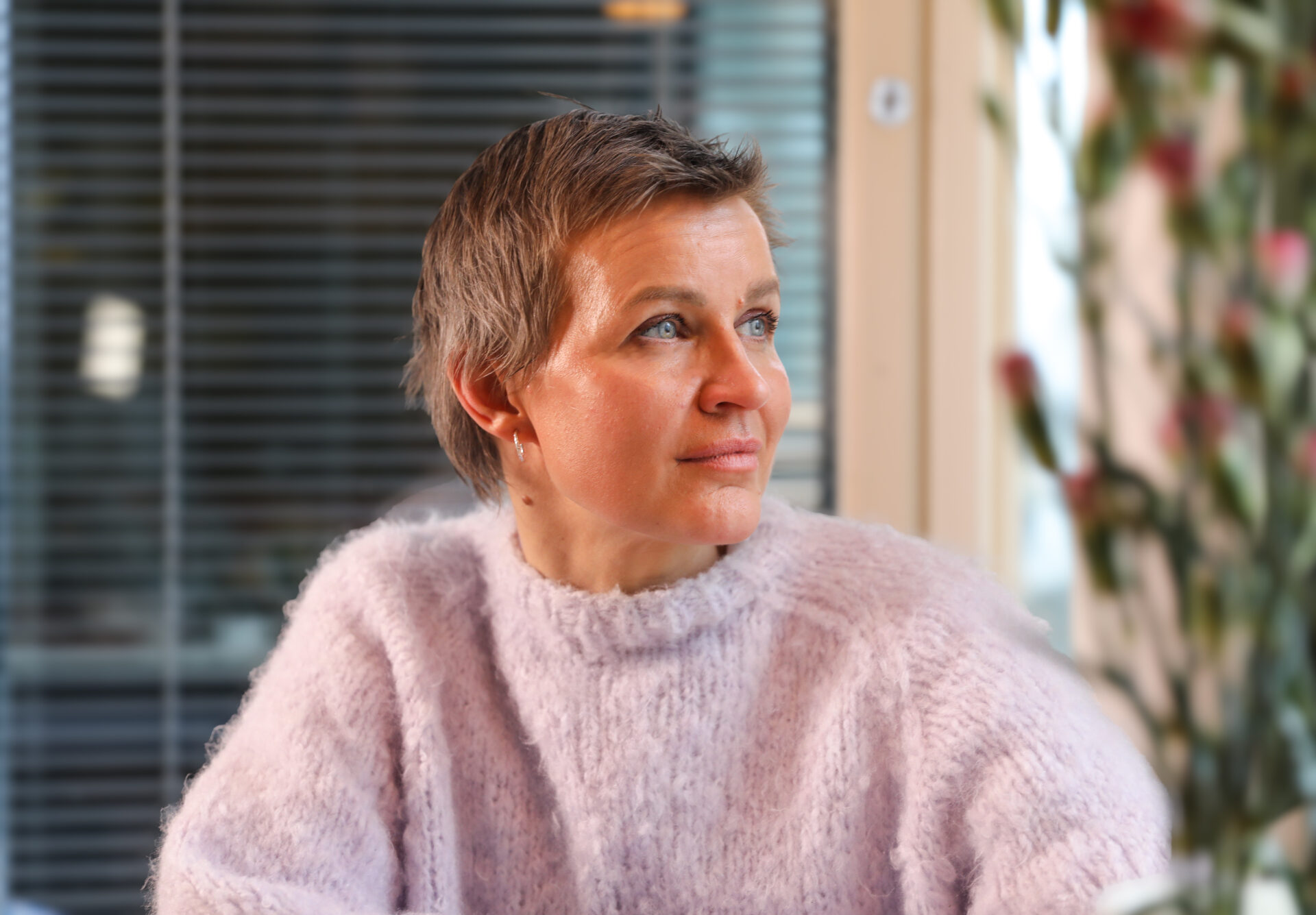
Milla Madetoja encourages people to join the Stem Cell Registry: “One phone call can change a life.”
In English: Milla Madetoja, who is recovering from leukemia, received a stem cell transplant from her sister. She encourages people to join the Stem Cell Registry.
“This isn’t my life, is this really happening?”
That was one of the first thoughts that went through Milla Madetoja’s mind when the doctor told her she had acute leukemia. Leukemia is a blood cancer in which no single tumor forms; instead, cancer cells circulate in the blood and reside in the bone marrow.
In early 2025, Madetoja was living a normal family life. Her days included working as a news anchor and TV news producer at Yle, driving her three children to their hobbies, cooking, and skiing. The 200-kilometer commute from her hometown of Tampere to Yle’s studio in Pasila, Helsinki, was long, but there was no noticeable fatigue. She went for blood tests as part of a routine check-up.
Suddenly, the results showed quite a few abnormalities.
“I thought maybe it’s something small. Maybe I’ll get a medicine for something, and life goes on.”
However, no explaining factor for the abnormalities was found. Eventually, a bone marrow sample was taken. Bone marrow is the tissue inside the bones where blood cells are produced. The sample revealed the seriousness of the situation.
The Diagnosis Stopped Everything
It was a Monday morning in February, after a normal work weekend. Training had gone as usual. The doctor sat down in the chair opposite her and began to speak. After that, Madetoja’s memories are hazy.
“When the doctor said the word ‘leukemia,’ it knocked me to my knees as much as possible. It was a moment that split my world in two. There is life before and after the diagnosis.”
Treatment at Tampere University Hospital began immediately and in full scale, and everything in Madetoja’s daily life came to a halt. When the doctor immediately wrote a long sick leave, Madetoja realized how serious the situation was.
Treatment started with a seven-day continuous cycle of chemotherapy. Chemotherapy wipes out the body’s immune system. Because of the risk of infection, she could not even go outside, let alone anywhere else in the hospital.
“Starting the treatment felt like jumping onto a full-speed train. I had no choice but to jump on,” Madetoja describes.
The chemotherapy was exhausting, and the days passed filled with uncertainty. Mornings always started the same way, with blood tests, breakfast, medication, and measurements. The entire treatment period, lasting several weeks, took place in an isolation room. Being separated from others, the nausea and pain caused by the treatments, and the uncertainty of the future made the weeks feel dark.
“I was placed wall-to-wall with my own thoughts. At some point, I realized I had to go through them; otherwise, I couldn’t move forward.”
Madetoja did not recognize herself. She had always been strong, energetic, and optimistic. Who was this person lying in the hospital bed crying?
“Then a wonderful nurse said that the day will come when you will get your strength back.”
Madetoja underwent two cycles of chemotherapy in total. Both responses were good.
“However, the doctors assessed that with my disease profile and risk level, a stem cell transplant would be necessary.”
A New Path with a Stem Cell Transplant
Stem cell transplants are used, for example, to treat leukemia and other malignant blood disorders when all other options have been tried. The goal of a stem cell transplant is permanent recovery. Healthy stem cells collected from a volunteer donor replace the patient’s diseased stem cells.
Madetoja had hoped the situation wouldn’t be severe enough to require a stem cell transplant.
“I cried for a moment, but then I thought, let this be the path I will now take.”
In a stem cell transplant, the patient’s diseased bone marrow is destroyed with preparative treatment, and their immune system is suppressed with medication to allow the donor’s stem cells to take hold and grow without being rejected. The immunological cells from the donor’s stem cell graft replace the patient’s original marrow and destroy any remaining malignant cells.
Each year, around 150 patients in Finland need the help of a voluntary stem cell donor. About one in six of them is a child.
“When the decision to perform the transplant was made, I just hoped that somewhere in the world the right donor could be found for me.”
Days dragged on as Madetoja waited at home for a call from the doctor about a possible stem cell donor. Outside, the spring sun was rising, and the grass was just beginning to turn green.
“The clock hand always approached four in the afternoon, and I realized that the call wasn’t coming today either.”
Often, siblings or parents can also be tissue-compatible. Madetoja’s older sister was also tested.
Then one day, the call came—the one that changes a life.
“My older sister Kukka’s tissue type was compatible with mine.”
A Second Life from Her Sister
It was almost May Day. The air carried the promise of summer, and people were seen on the streets with balloons. Madetoja drove with a friend to Turku for the stem cell transplant and settled back into the isolation room, where she would spend weeks—long enough for spring to turn into summer. Stem cell transplants in Finland are performed only in Helsinki (HUS) and Turku (TYKS).
Before the transplant, Madetoja received another several days of intensive chemotherapy to destroy her own bone marrow. Then came transplant day—the start of a new life. The day before, stem cells had been collected from her sister. The collection, which lasted about five hours, went well. Now her sister Kukka stood in the same room as the cells were infused into Madetoja’s body via a central venous catheter.
Then they waited. Stem cell transplants carry risks. In some cases, the transplant does not take.
A few weeks later, one of the counts shifted slightly. Day by day, week by week, her condition began to improve.
I got this life that I have now from her.– Milla Madetoja
Life’s Small, Bright Moments
At the moment, Madetoja is doing well. Or as well as one can in her situation. A strong physical condition allowed her treatments to be carried out at full intensity and has helped her recovery. Still, her immune system is relatively low, and she is currently waiting for vaccinations.
“It’s a long road, but I keep finding my way back more and more to myself.”
Through her illness, Madetoja has realized how fragile life is and how everything can change in a single moment. Still, she shies away from the idea that she should already have a pocketful of life lessons and insights.
“But the small, everyday moments of life—I notice those very clearly right now. And I am immensely grateful for every morning that begins.”
Madetoja becomes emotional when she talks about her sister as a donor.
“I got this life that I have now from her.”
She reflects on how, for many illnesses, only medicine can help. How doctors save lives.
“But with the Stem Cell Registry, any ordinary 18–35-year-old can help.”
“If a person can give another person life, there is no greater gift.”
The Stem Cell Registry is a network of volunteers, among whom a suitable donor is sought for seriously ill patients. The registry is global. Without a transplant, a patient may not survive. In 2025, 179 stem cell transplants were facilitated through Finland’s Stem Cell Registry.
Among adults, 50–70% recover with a stem cell transplant. For child patients, the recovery rate can be as high as 90%. Stem cells collected from young donors yield better treatment outcomes. That is why new members are especially encouraged to be young, healthy individuals.
Although in Madetoja’s case her sister was a compatible donor, one in five patients in Finland cannot find a suitable match.
“Many people reflect on the feeling of meaning in life. Ultimately, feeling needed, feeling that your life matters, is in a way a condition for our living and being. If a person can give another person life, there is no greater gift. And by joining the Stem Cell Registry, it is possible.”
Today, Madetoja can drive a car. She can go grocery shopping again. She has returned to exercise, which is her lifeline. She enjoys her family, cooking, being outdoors—even cleaning.
All from the small, bright moments.